Considering our Standards: a closer look at the BPC’s Standard 4
The BPC protects the public by holding a set of standards that all of our Registrants must meet. These standards set out how we expect our Registrants to behave professionally and we use them to help us decide the outcomes of our Fitness to Practise processes.
As of April 2025, our Standards, Conduct, Practice and Ethics document came into effect. These standards replace our BPC Code of Ethics and Ethical Guidelines document published in 2011 as the standards all Registrants must meet.
In the Considering our Standards series, we’re looking at each standard with precision from a practice-based perspective and from a regulatory angle. We’ll be talking to experts in our team to break down the importance in each Standard. In this instalment, we’re taking a closer look at: Standard 4.
Any law referred to is subject to amendments by the government, we will review this regularly to make sure what we reference is up-to-date. If you notice any out of date legislation on this page, please contact us.
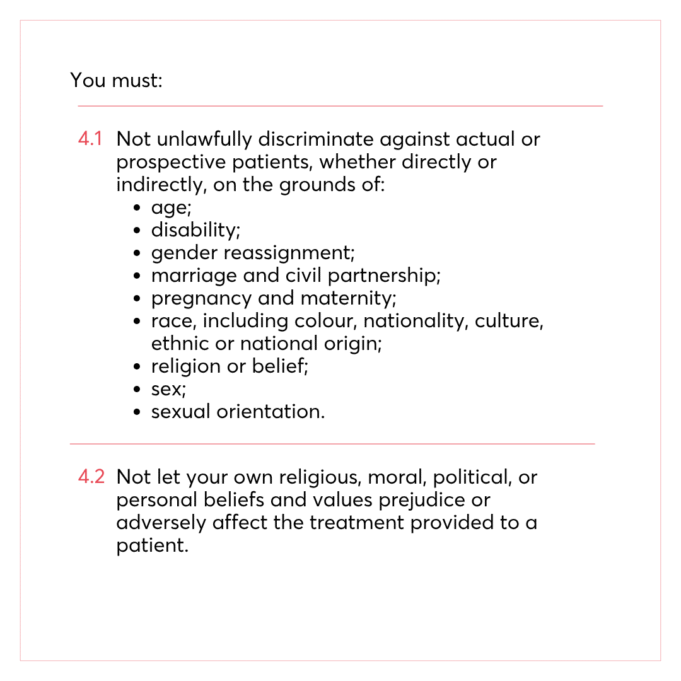
Standard 4: Must not unlawfully discriminate

What does Joanne, our Director of Professional Practice, say about Standard 4?
“It is important to be aware of how your personal beliefs influence you and your work. Remain open in the ability to reflect, examine and analyse your prejudices and openly discuss these with trusted a supervisor, analyst or colleague.
To avoid discrimination, remain committed to fairness and appreciate difference between people, as a part of your practice. Be aware of the language you use when working with patients. Every patient is entitled to fair treatment irrespective of ethnic background, gender, religion, disability or sexuality.
It is each Registrant’s responsibility to develop their knowledge and understanding of their own biases and prejudices through personal therapy, reading and training. Remember to remain up-to-date with any changes in discrimination legislation. It is important to be aware of the social and cultural context in which you work, and have an understanding around issues like the use and misuse of power as well as concepts such as intersectionality.
Put yourself in the patient’s shoes, ask yourself if you are being truthful, respectful and fair. Empathy is central to this Standard.”
What does Sharon, our Director of Legal, say about Standard 4?
“The Equality Act 2010 outlines the protected characteristics that Registrants must not discriminate against. A failure to do so will result in a Fitness to Practise investigation. Registrants must also ensure their own beliefs – religious, moral, political or personal – are not prejudicial when providing treatment to a patient.
When a patient reveals parts of their identity to their therapist, this should be respected. These factors should be considered thoroughly and respectfully. Your work with patients should be in line with your training and without prejudice. It’s important to reflect upon your practice with your supervisor and keep up with your CPD in order to think about your approach with every patient.”
Your obligation to Duty of Candour means you should be open and honest with yourself and with your patient about whether you have made a mistake or an error of judgement. Explore this through discussion with your patient and in supervision. Consider apologising if this feels appropriate. Remain reflective as you move through these steps.
If the patient wishes to make a formal complaint, they are within their rights to do so and you should inform them on how they can raise their concern via the BPC.
These issues, in the context of power and transference, are important to consider. It could be useful to talk about them in different settings, such as a CPD group, ethics committees or clinical seminars.
It’s important to reflect on your competence and whether you can work with patients with specific experiences or backgrounds.
Being a reflective practitioner means you have a responsibility to continue thinking about your competence in terms of your own capacity for understanding difference, whilst being open to considering unconscious bias. Discuss these themes in different contexts and consider further training, consultation, supervision and personal therapy.

Black History Month 2024 Resources
Learn more