Considering our Standards: a closer look at the BPC’s Standard 5
The BPC protects the public by holding a set of standards that all of our Registrants must meet. These standards set out how we expect our Registrants to behave professionally and we use them to help us decide the outcomes of our Fitness to Practise processes.
As of April 2025, our Standards, Conduct, Practice and Ethics document came into effect. These standards replace our BPC Code of Ethics and Ethical Guidelines document published in 2011 as the standards all Registrants must meet.
In the Considering our Standards series, we’re looking at each standard with precision from a practice-based perspective and from a regulatory angle. We’ll be talking to experts in our team to break down the importance in each Standard. In this instalment, we’re taking a closer look at: Standard 5.
Any law referred to is subject to amendments by the government, we will review this regularly to make sure what we reference is up-to-date. If you notice any out of date legislation on this page, please contact us.
Standard 5: Not engage in conversion practices
What does Sharon, our Director of Legal, say about Standard 5?
“Registrants must not offer conversion practices. Engaging publicly with any endorsements of conversion practices will lead to a Fitness to Practise investigation. If it’s suspected that an initial assessment touched on themes of conversion practices, this will lead to an investigation also.”
What does Joanne, our Director of Professional Practice, say about Standard 5?
“When work with a patient involves exploring their sexuality and gender, it’s important that you’re aware of your own fears and anxieties, value-judgements and how you are influenced by social and cultural norms. As part of this, you must also acknowledge the power differential in the consulting room between you and the patient and how this affects discussions. These considerations can also apply to teaching and publishing. Throughout your practice, it’s important to be aware of the weight that your words hold by virtue of your professional role.”
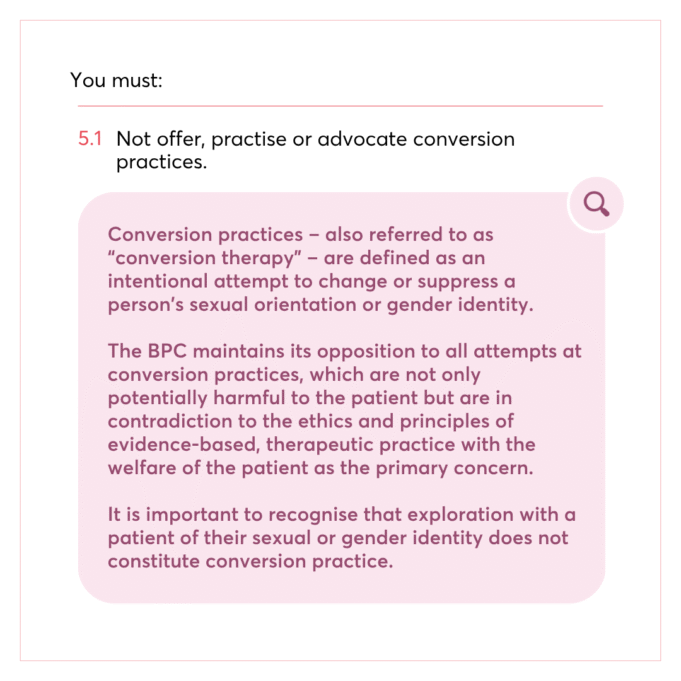
At the BPC, we refer to ‘conversion practices’ as such rather than conversion therapy because we do not view it as a type of therapy.
BPC is opposed to any misuse of counselling or psychotherapy that intentionally attempts to change or suppress a person’s sexual orientation or gender identity. We consider this not only to be ineffective, but potentially harmful (since confusion and frustration may precipitate mental health issues for any person subjected to such practices) and in complete contradiction to the ethics and principles of evidence-based, therapeutic practice with the welfare of the patient as the primary concern.
Explore this with your patient and in your own supervision or with colleagues. Remain open and reflective as you move through this with your patient. Reflect on whether you have harmed the patient and consider apologising if you think this is appropriate. If the patient wishes to make a complaint about you, you should instruct them on how to do so via the BPC.
You may also consider contacting your insurance provider for legal support if you think this is necessary.
As a therapist, you should be open to explore a patient’s fears and anxieties around their sexual orientation, questions about their gender and their own internalised discrimination. In your role, it’s your responsibility to discuss why they’ve requested this. Psychoanalytic practitioners should aim to examine these reasons without reinforcing conversion practices.
It is important to be able to discuss these issues in supervision and in ethical committees and discussion groups.
If you’re able to find out more about these practices, do so. If you gather further information that reinforces your concerns, refer to the BPC’s guidance on Duty of Candour that outlines the professional responsibility to be open, honest, and transparent when things go wrong or when you think a patient is being harmed.