Considering our Standards: Standard 2
The BPC protects the public by holding a set of standards that all of our Registrants must meet. These standards set out how we expect our Registrants to behave professionally and we use them to help us decide the outcomes of our Fitness to Practise processes.
As of April 2025, our Standards, Conduct, Practice and Ethics document came into effect. These standards replace our BPC Code of Ethics and Ethical Guidelines document published in 2011 as the standards all Registrants must meet.
In the Considering our Standards series, we’re looking at each standard with precision from a practice-based perspective and from a regulatory angle. We’ll be talking to experts in our team to break down the importance in each Standard. In this instalment, we’re taking a closer look at: Standard 2.
Any law referred to is subject to amendments by the government, we will review this regularly to make sure what we reference is up-to-date. If you notice any out of date legislation on this page, please contact us.
Standard 2: Ensure a safe environment for you & your patients
What does Sharon, our Director of Legal, say about Standard 2?
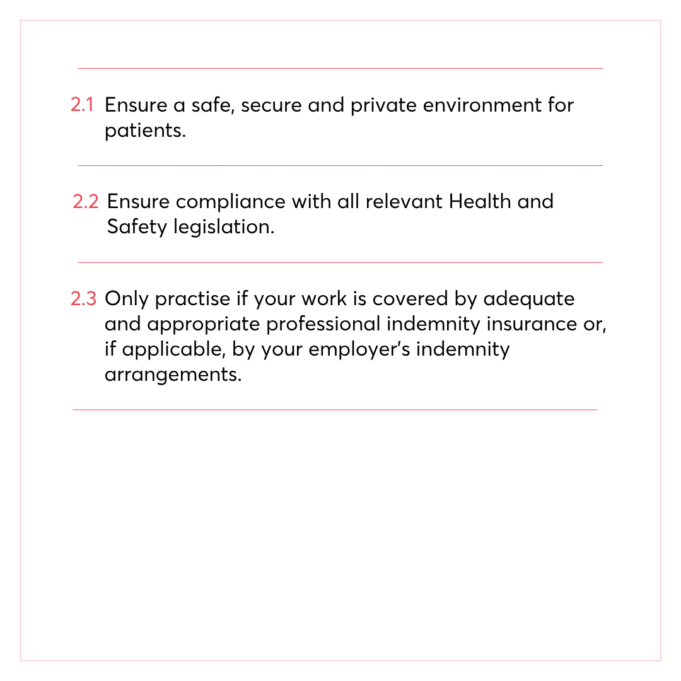
“This standard asks you to consider these factors: your patient’s safety, their privacy, the relevant health and safety legislation in place, and indemnity insurance. You must consider the practicalities of the space you’re welcoming patients into and make sure it’s in line with current health and safety legislation. You must also have appropriate indemnity insurance in place.
With regards to indemnity insurance, it’s important to carry out a number of checks with your insurance company around whether you are covered to work in the setting that you plan to e.g. working online or working abroad. If you change the age group of the patients you normally work with, this must be checked with your insurance, to ensure that you’re covered. It is always worth checking with your insurance company if you make any changes to your practice. Failure to consider these factors can result in a Fitness to Practise investigation.“
What does Joanne, our Director of Professional Practice, say about Standard 2?
“This standard is about focusing on the external environment you provide for your patients. Providing a private space is vital in order to preserve confidentiality and help your patients feel safe. This also means considering practical factors like whether sound is likely to travel or whether disturbances could occur.
The environment you provide must be appropriate and respectful, you must remain aware of how different patients may respond to their environment and ensure that you listen to any anxieties that arise around this.
You must also ensure that you keep up-to-date with advice from the government in public health situations. In general, it’s important to be aware of potential to spread illnesses, especially if you or any of your patients are infectious or have a weak immune system.
If you are working online with patients, we recommend you follow our official guidance on working online that you can find here.”
The majority of therapists practise in a consulting room that’s secure and has suitable amenities. A safe environment for a patient should revolve around allowing the patient to feel that they’re in a space where confidentiality is key and appropriate boundaries are in place.
The cost of your individual insurance policy will vary between providers and will depend on the nature of the cover that you require. It can be helpful to get several quotes from a number of providers before committing to a policy.
It could also be that case that you are covered by your employer’s indemnity insurance. If you are unsure about this, you should check this with your employer.
Many BPC Registrants have practices in their homes. Having a separate, neutral space that can ensure privacy for your patients is important. Consider the practicalities about maintaining a safe space, such as eliminating any hazards or risks to privacy.
Consider the different needs of each of your patients. There may be specific requirements to consider, like a waiting room if parents are accompanying younger patients. These requirements will differ according to patient needs. You are not obliged to provide toilet facilities although this can be a valuable addition especially when seeing children.
Yes, it’s vital that you consider all of the factors detailed on this page, even when working online.
Consider having a plan in place if you are working with a patient where there are concerns about risk and safety. Always carefully consider all of the risks that could occur and think about how you would respond.
Discuss fully with the patient, and their carer if appropriate, and consider involving another professional, such as a medical doctor, psychiatrist or safeguarding lead if the patient is at risk or becoming unwell.
Please consult our safeguarding guidance thoroughly so that you are aware of the actions you should carry out if you become seriously concerned about your patient’s welfare. In such situations it is important to keep a record or notes of any actions.